
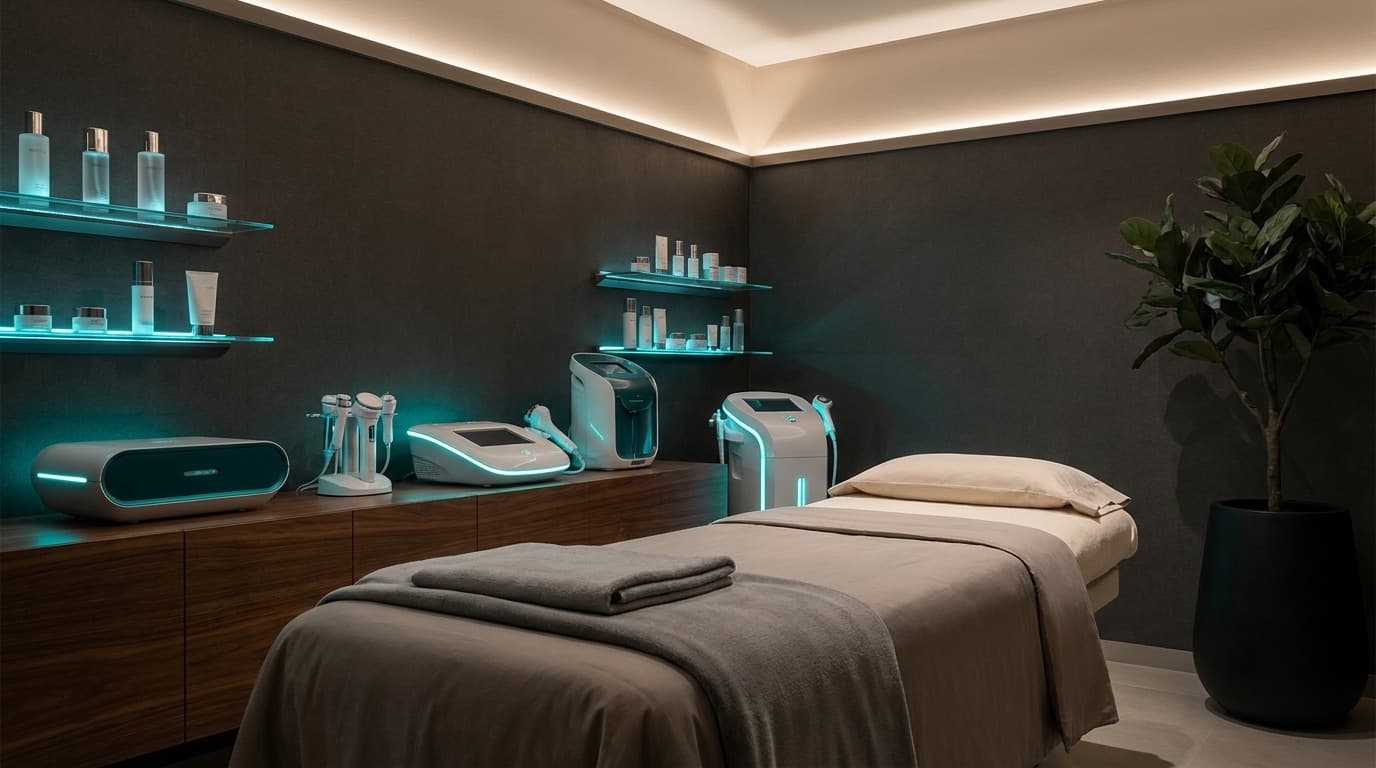
Walk into most med spa marketing and you find the same problem. Beautiful feed, empty calendar. Pretty photos that never turn into a booked Botox appointment or a filler consult. The gap is not talent or equipment. It is a system that connects what you post to who actually books.
I run High Arc Media, an Atlanta agency, and med spas are one of the verticals we know best. dermani MEDSPA is one of our clients. What follows is the exact way I think about med spa marketing that ends in treatments on the books, not likes on a post.
Why med spas are a different animal
You are not selling a $30 product on impulse. You are asking someone to trust you with their face, pay hundreds or thousands of dollars, and come back every few months. That changes everything about how you market.
Three things make aesthetics its own category.
First, you sell on proof. A skincare brand can talk about ingredients all day. A med spa lives or dies on the before-and-after. People want to see a real jawline sharpen after Kybella, real skin clear up after a chemical peel, real lips that still look like lips. Photos and video of actual results do more selling than any headline you can write.
Second, the money is high-value and it repeats. One patient who trusts you is not a single sale. Botox every three to four months, filler once or twice a year, a membership, the friend she refers. The lifetime value of a good patient is enormous, which means you can afford to spend real money to earn that first booking and still come out ahead. This is the part most spa owners miss when they stare at a marketing invoice. You are not paying to acquire a single appointment. You are paying to acquire a relationship that pays you for years. Once you frame it that way, spending $150 to book a new patient who will bring you thousands over her lifetime stops feeling expensive and starts feeling obvious.
Third, and this is the one most agencies ignore, there are rules. You are marketing a medical service. Before-and-after photos need written patient consent. Your claims cannot be misleading under FTC and state medical board standards. You cannot promise a guaranteed result. This is not a reason to play it safe and post nothing. It is a reason to build a content process that stays clean while still showing the proof that sells. Get consent in writing, disclose that results vary, keep releases on file, and run it past your compliance advisor. Done right, compliance is a moat. The spas cutting corners get themselves in trouble while you build trust.
Hold those three truths in your head, because the whole system is built on them.
The content engine: proof on a schedule
Here is where most med spas lose. They post when they remember to. A great result photo one week, then silence for ten days, then a random meme, then a Groupon-looking promo. That is not a content engine. That is noise.
The fix is a calendar. Every week, on repeat, you produce and post the content that actually moves a med spa:
Treatment and result content is your backbone. Real before-and-afters with consent. Short clips of a treatment happening so the experience feels safe and familiar before someone ever walks in. A provider explaining what a HydraFacial actually does and who it is for. This is the stuff that answers the quiet question every prospect has: will this work, and will it be worth it.
Patient and creator UGC is your trust accelerator. A raw phone video of a real patient talking about her results outsells a polished ad, because it does not look like an ad. Encourage happy patients to film a quick clip. Bring in local micro-creators to try a treatment and post honestly. UGC feels like a friend's recommendation, and in aesthetics, that is the strongest signal there is.
Short-form that shows the experience is what earns reach. The walk-in, the calm room, the provider's hands, the reveal. People are nosy about aesthetics. They want to see what it is really like inside. Short-form video built around the actual experience is what the algorithm pushes and what makes a stranger think "I could see myself there."
You do not need a film crew for any of this. Most of the content that books med spa treatments is shot on a phone in the treatment room, on days you were already seeing patients. What you need is a repeatable way to capture it, a plan for what to post and when, and someone editing it so it looks intentional instead of thrown together. That is the difference between a spa that posts once a week for a month and gives up, and one that builds a real library of proof. The first one blames "social media doesn't work for us." The second one has new patients saying "I saw you on Instagram" at the front desk.
This is the core of our social media marketing work, and it is why the calendar matters more than any single viral post. Consistency is what builds a library of proof a new patient can scroll through and think, these people know what they are doing.
Paid social tuned to cost-per-booking, not reach
Content builds trust over time. Paid social is how you turn on demand this month. But you have to run it right, and most med spas do not.
The mistake is chasing reach. You boost a post, it gets 40,000 views, and you feel good. Then you look at the calendar and nothing changed. Reach is not the goal. A booked consult is the goal, and the number that tells you the truth is cost-per-booking.
Set your campaigns up to optimize for booked appointments or lead form completions, not impressions. Feed the algorithm the outcome you actually want and it will find you the people likely to take that action. Judge every dollar against one question: what did it cost me to book a treatment, and is that less than what the treatment earns? If yes, you scale. If no, you fix the funnel before you spend more.
Retargeting is where the real money hides. Most people who see your ad or watch your video do not book the first time. Aesthetics is a considered purchase. Someone researches for days or weeks. So retarget everyone who watched your video, clicked your ad, or visited your site, and keep showing them proof and a reason to book now. The person who watched three of your before-and-afters and then saw a limited new-patient offer is far closer to booking than any cold audience. This warm traffic almost always returns the lowest cost-per-booking in the whole account.
Offers close the loop. A clear new-patient offer, a first-treatment special, or a limited membership deal gives the fence-sitter a reason to act today instead of "someday." Keep it honest and on-brand, not desperate discounting. The offer is the nudge, the proof is the reason.
If you want this done right, paid ads for a med spa is its own skill. The targeting, the creative testing, the retargeting sequences, the tracking that ties a click to a booked chair. It is not "boost post" money. It is a system.
Booking-focused landing pages and fast follow-up
You can run perfect content and perfect ads and still lose the patient in the last ten feet. That last ten feet is your landing page and your follow-up.
Send paid traffic to a page built for one job: book this treatment. Not your homepage with fourteen links. A focused page with the treatment, the proof, a couple of reviews, the offer, and a booking button that works on a phone in two taps. Every extra field, every extra click, every "call us during business hours" is a patient you just lost to the spa down the road with an easier button.
Then move fast. When someone fills out a form or asks a question, speed wins. A lead that gets a reply in five minutes is worlds more likely to book than one that hears back the next afternoon. People shop several providers at once in this category. The first spa to respond, answer the nervous question, and offer a time usually gets the booking. Build the follow-up so no inquiry sits cold, whether that is a fast text back, an automated reply that offers times, or a front desk trained to treat every lead like money on the table. Because it is.
Reviews and reputation: the trust layer under everything
Before a new patient books, they Google you. They read your reviews. They look at your rating next to the spa two miles away. In aesthetics, your reputation is doing the selling while you sleep, for better or worse.
So make reviews a system, not an accident. Ask every happy patient, at the right moment, right after a result they love. Make it one tap to leave one. Respond to reviews, the great ones and the rough ones, because prospects read how you handle criticism as closely as the praise. A steady flow of recent, specific, five-star reviews is often the deciding factor between you and a competitor, and it makes every ad dollar and every piece of content work harder because the trust is already there when they land.
Reviews are the floor the whole system stands on. Weak reviews and the best content in the world still leaks patients.
The system, laid out
Here is how the pieces fit together and what "good" actually looks like at each layer.
| Layer | What it does | What good looks like |
|---|---|---|
| Content engine | Builds trust and reach with proof on a schedule | Consistent weekly before-and-afters, treatment clips, and short-form that shows the real experience, all with consent |
| Patient / creator UGC | Adds social proof that feels like a friend | Real patient clips and local creator content that reads honest, not scripted |
| Paid social | Turns on demand now | Campaigns optimized for booked appointments, judged on cost-per-booking, not reach |
| Retargeting | Recovers the people who did not book the first time | Warm audiences of video-viewers and site-visitors served proof plus an offer, at the lowest cost-per-booking |
| Landing page | Converts the click into a booking | One-treatment, one-CTA page that books in two taps on mobile |
| Fast follow-up | Wins the last ten feet | Every inquiry answered in minutes, times offered, nobody left cold |
| Reviews | Holds up the trust the rest depends on | Steady flow of recent five-star reviews, every review answered |
No single layer is the answer. A viral reel with no booking page leaks patients. A great landing page with no traffic sits empty. The whole thing works as a loop.
Put it together into one repeatable monthly system
Zoom out and the month looks simple, even if each piece takes real work.
You produce a batch of proof content and post it on a calendar, every week, no gaps. You run paid social to booked appointments and retarget everyone who engaged. You send that traffic to a clean booking page and follow up in minutes. And you keep the review engine turning under all of it. Then you read one number above all others, cost-per-booking, and you pour more into what books treatments and cut what does not.
That is the whole game. It is not a secret tactic. It is a system run consistently, month after month, while your competitors post when they remember to and boost for reach.
This is the kind of work we build for med spas at High Arc Media. If you want proof that the content side moves, we report a 600 percent average reach increase across our social media clients. Reach is only the top of the funnel, but it is the top of the funnel that ends in a booked chair.
Want this built for your spa?
If your calendar has gaps and your feed is prettier than your booking numbers, the fix is a system, not another random post. I can look at your current med spa marketing and show you where treatments are leaking out of the funnel.
Book a call and let's map out what a real content and paid system would look like for your spa.