
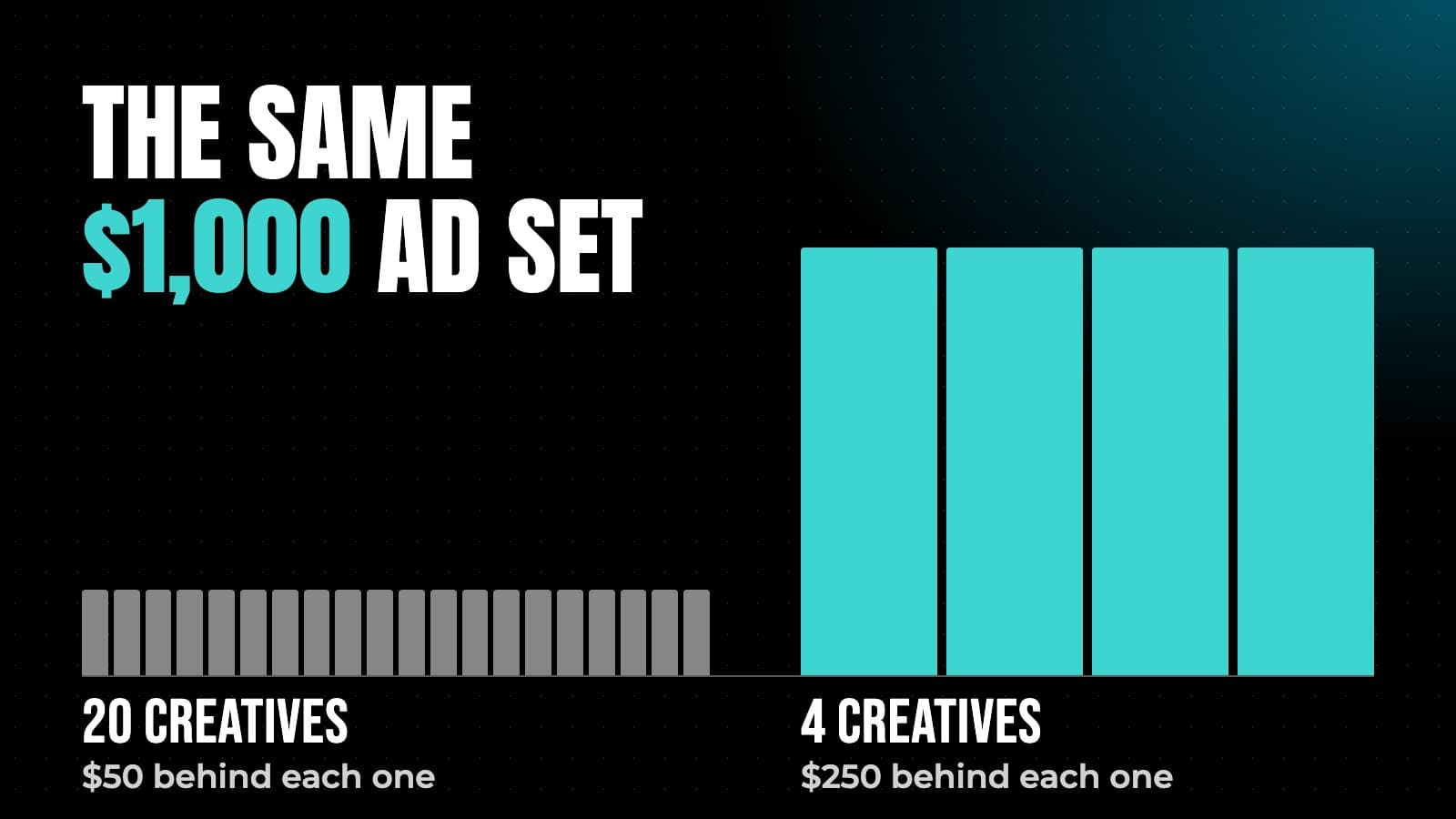
Your agency says you need more content. Every ad guru in your feed says the same thing. Content, content, content. So you pay for 20 new creatives, load them into a $1,000 ad set, and a month later nobody can tell you which ones worked.
The "more creative is better" advice is true and false. How many ad creatives you actually need comes down to your budget, and the volume advice mostly holds for brands with large ad budgets. I run High Arc Media. We make content and run paid ads for a living, so I have every reason to sell you more of it. I'd still rather you buy the right amount.
How many ad creatives does an e-commerce brand need per month? It depends on your ad spend. At around $2,000 a month, you'll only really benefit from 4 to 6 creatives. At around $5,000 a month, 8 to 12. At $10,000 to $30,000 a month, 15 to 30 becomes a big advantage, because each ad can still get real money behind it. Whatever you spend, every ad needs enough budget to make some noise before you decide whether it works. Meta says ad sets usually exit the learning phase after about 50 results in a week, and it warns that too many ads at once can hurt performance. So more creative isn't automatically better. The quality of the creative, the attention it gets, and how well it fits your audience matter more than the count.
Is more ad creative always better?
No. Fresh creative matters, but only if your budget can back it. Ads wear out, and you won't find your next winner without testing. Meta's own learning phase guide calls testing new creative "essential for improving your performance over time."
That same page also tells you to "avoid high ad volumes," because "the delivery system learns less about each ad and ad set than when you create fewer ads and ad sets." Meta's ad volume guide is even blunter: "too many ads can result in worse performance."
So Meta says both things, and the gurus only quote one.
Searching for a number won't settle it either. One guide says 3 to 4 new creatives a month at $10,000 to $25,000 in spend. Another says around 50 new ads a month for every $25,000. So here's how I'd size it.
How many ad creatives can your budget carry?
Use your monthly ad spend to set the number.
| Monthly ad spend | Creatives per month | Where your focus goes |
|---|---|---|
| Around $2,000 | 4 to 6 | A few strong ads with real money behind them. Replace the ones that fail. |
| Around $5,000 | 8 to 12 | A few different ideas, with budget left over to back the winners. |
| $10,000 to $30,000 | 15 to 30 | Volume starts paying off. You can test new ideas and scale winners at the same time. |
The $2,000 and $5,000 ranges come out to about $400 to $500 of monthly spend behind each creative, which gives you a quick way to check your own plan. Spend $3,000 a month on 30 creatives and each one gets $100. The top range lines up with Digital Polo's planning table, which puts brands spending $15,000 to $50,000 at 15 to 30 variants a month. If your cost per purchase runs high, stay at the low end, because each ad needs more money to show you anything.
These are monthly totals, not how many should run at the same time. Live at once, fewer tends to win. AdScale looked at more than 1,200 e-commerce ad accounts and found click-through rate peaked at 4 to 6 active creatives per ad set. Past 7, it flattened out while CPMs climbed 8% to 12%. That's one software company's data, but it lines up with what Meta tells advertisers.
What happens when you put 20 creatives in a $1,000 ad set?
Each one gets too little money to tell you anything. Split evenly, that's $50 per creative. At a $25 cost per purchase, that's two purchases each, and nobody can call a winner off two purchases.
It won't split evenly, either. Delivery tends to bunch up on a few ads early, so the rest barely run. Then you read the report and decide those ads failed, when they never really got tested.
There's a second problem. Your customers aren't one type of person. Someone buying a gift, someone who's followed you for a year, and someone who found you this morning won't react to an ad the same way. A small amount of spend doesn't reach enough of those different people to tell you whether the ad works, so the results can get pretty misleading. You can kill an ad that would've been your best one, or scale one that got lucky.
How many conversions does Facebook's learning phase need?
About 50. Facebook tells you when an ad set is learning, right in the Delivery column of Ads Manager. Meta says an ad set usually exits that phase after about 50 results in the week after its last significant edit. If you're optimizing for purchases, that's about 50 purchases.
Two details matter for your creative plan. The count is per ad set, so spreading your budget across more ad sets means each one gets there slower. And adding a new ad to an ad set is a significant edit, same as any change to an existing ad's creative. Both send the ad set back into learning.
So what can your budget buy in a week? This table uses two example costs per purchase. To run your own number, divide your monthly spend by 4.33, then by your cost per purchase.
| Monthly ad spend | Sales a week at $25 each | Sales a week at $50 each |
|---|---|---|
| $2,000 | 18 | 9 |
| $5,000 | 46 | 23 |
| $10,000 | 92 | 46 |
| $20,000 | 185 | 92 |
| $30,000 | 277 | 139 |
Look at the $5,000 row. At $25 a purchase, every dollar you've got barely gets one ad set to the line. One Shopify brand on our results page got down to $22.94 per purchase, and even at that cost, 50 purchases takes $1,147 a week. That's about $5,000 a month for a single ad set.
Now look at the bottom of the table. At $30,000 and $25 a purchase, you can feed five ad sets at once. That's why more creative is such a big deal at larger budgets. There's enough money for the tests to finish.
If an ad set can't get there, Ads Manager shows "Learning limited." Meta defines that as an ad set that's unlikely to get about 50 results in the week after its last significant edit, and "running too many ads at the same time" is one of the causes it names. Selling through Shops? The bar is lower: 17 purchases through your website and 5 through Meta.
Can you spot a losing ad before 50 purchases?
Yes. Fifty is when Meta's system settles down, not how long you have to wait to judge an ad. If something really isn't performing, you'll usually see signals sooner:
- People aren't stopping. If almost nobody watches past the first few seconds, the hook isn't doing its job.
- They watch but don't click, which usually means the ad is entertaining without selling anything.
- They click but don't add to cart. Now look at the offer, the product page, and whether the ad promised something the page doesn't show.
- Money keeps going out with no sales. A common rule of thumb is three to five times your target cost per purchase before you kill an ad for having no sales. At $25 a purchase, that's $75 to $125, more than the $50 each ad got in that 20-creative example.
Calling a winner takes longer than calling a loser, because a few cheap early purchases can be luck. Judge the ones still standing on the numbers that tie to revenue, and give them more budget before you trust them.
How should you use fresh creative on a small budget?
Use it to replace what failed. You still want fresh creative at $2,000 a month, but you don't need it to fill up the ad set.
- Launch a small batch of ads that are actually different from each other.
- Give them enough spend to make some noise, then cut the clear losers.
- Keep the winners running and leave them alone.
- Bring in new creative as a batch when you have failures to replace. Adding ads one at a time every few days keeps sending the ad set back into learning.
Doesn't Meta's Andromeda update mean you need more creative?
You need more variety, which is different from more volume. You'll hear this argument a lot right now. Andromeda is the system Meta uses to narrow all eligible ads down to a small set of candidates. Meta's engineers wrote in October that generative AI tools have helped advertisers "rapidly create hundreds of millions of new ads." So yes, there's a lot more creative out there.
But the recommendation that came out of Andromeda is creative diversification, and that's a different thing from volume. Meta's ad volume guide says it plainly: "Decrease ads per ad set, but maintain diverse creative assets per ad set."
Diverse means different ideas: a founder telling the story, a customer review, a product demo, a comparison against what people use now. Fifteen versions of one ad with new headlines is still one idea. For video, start with these video ad strategies, and if you sell apparel, these five formats for clothing brands. And Andromeda doesn't change the math above, since Meta's learning phase guide still says about 50 results.
What matters more than the number of creatives?
The quality of the creative, the attention it gets, and how well it's built for your target audience. Before you pay for another batch, ask this about every ad:
- Would you stop for it if it weren't your brand?
- What grabs attention in the first few seconds, and does the rest of the ad hold it?
- Who is it for? An ad built around one buyer's real problem usually beats one that describes your product to everybody.
Four strong ads with real budget behind them will teach you more than 20 you made to hit a number.
We've seen thin budgets do this damage at the campaign level too. One Shopify account was running seven campaigns at once, most with a few hundred dollars behind them, at a 1.17 return on ad spend in October. Our paid media partner, Manga Media, collapsed them into one prospecting campaign and one retargeting campaign. By February, the account was at a 4.40 return on $8,143 in spend. Here's the full breakdown. That one was about campaign count instead of creative count, but it's the same mistake: too many places for not enough money.
Find out how much creative your budget can use
Creative is good. Just don't overdo it because the gurus keep saying more.
If you're paying for a stack of creative every month and can't say which ads are earning their keep, let's talk. Take a look at how we work with e-commerce brands and our paid advertising service, then book a call. Tell us what you're spending and we'll tell you how much creative it can carry, even if that's less than you're buying now.