
Every Meta ads guru says the same thing. Optimize for purchases. Always.
For most brands that's right. For a brand spending $2,000 a month on a $40 product, it's how you end up with an ad set that never leaves the learning phase, a cost per purchase that swings every week, and a dashboard that tells you nothing.
Meta's own help docs say the quiet part out loud. If your ad set can't get enough purchases, "consider choosing an optimization event that occurs more frequently. For example, move from purchases to add to cart." That line is on Meta's learning limited page. The gurus never quote it.
Here's when it applies to you, when it doesn't, and how to move back up once it stops applying.
What does "optimize for" actually tell Meta?
The optimization event is the thing Meta's system bids on. Meta defines it as "the outcome that our system bids on in the ad auction," and notes it "can be different from your campaign objective." You can run a Sales campaign and still tell the ad set to optimize for adds to cart.
Every time someone does the event you picked, Meta learns a little more about who to show the ad to next. Pick purchases, and it learns from buyers. Pick adds to cart, and it learns from people who got as far as the cart. The second group is bigger and a little less serious. That tradeoff is the whole decision.
Why does everyone say purchases?
Because the signal is cleaner. A purchase is a person who paid. Optimize for that, and Meta goes looking for more people like that. Optimize for a weaker event and it goes looking for people who do the weaker thing.
The advice is right when the ad set gets enough purchases to learn from. Meta's learning phase guide says an ad set usually exits learning after about 50 results in the week after its last significant edit. The optimization events page says the same: "We recommend around 50 optimization events, but some ad sets stabilize earlier."
Fifty purchases a week. Per ad set. Most small brands aren't close.
Where does purchase optimization break?
Do the math on your own account. Take your monthly spend, divide by 4.33 for a weekly number, then divide by your cost per purchase. That's how many purchases one ad set can log in a week if it gets the whole budget.
This table uses $30 and $50 per purchase, and assumes three adds to cart for every purchase. That ratio is generous. Baymard's long-running benchmark puts average cart abandonment a little over 70 percent, which works out to roughly three carts per order, and paid traffic usually runs worse than a site-wide average.
| Monthly spend | Purchases a week at $30 | Purchases a week at $50 | Adds to cart a week at $30 | Adds to cart a week at $50 |
|---|---|---|---|---|
| $2,000 | 15 | 9 | 45 | 27 |
| $5,000 | 38 | 23 | 114 | 69 |
| $10,000 | 76 | 46 | 228 | 138 |
| $20,000 | 153 | 92 | 459 | 276 |
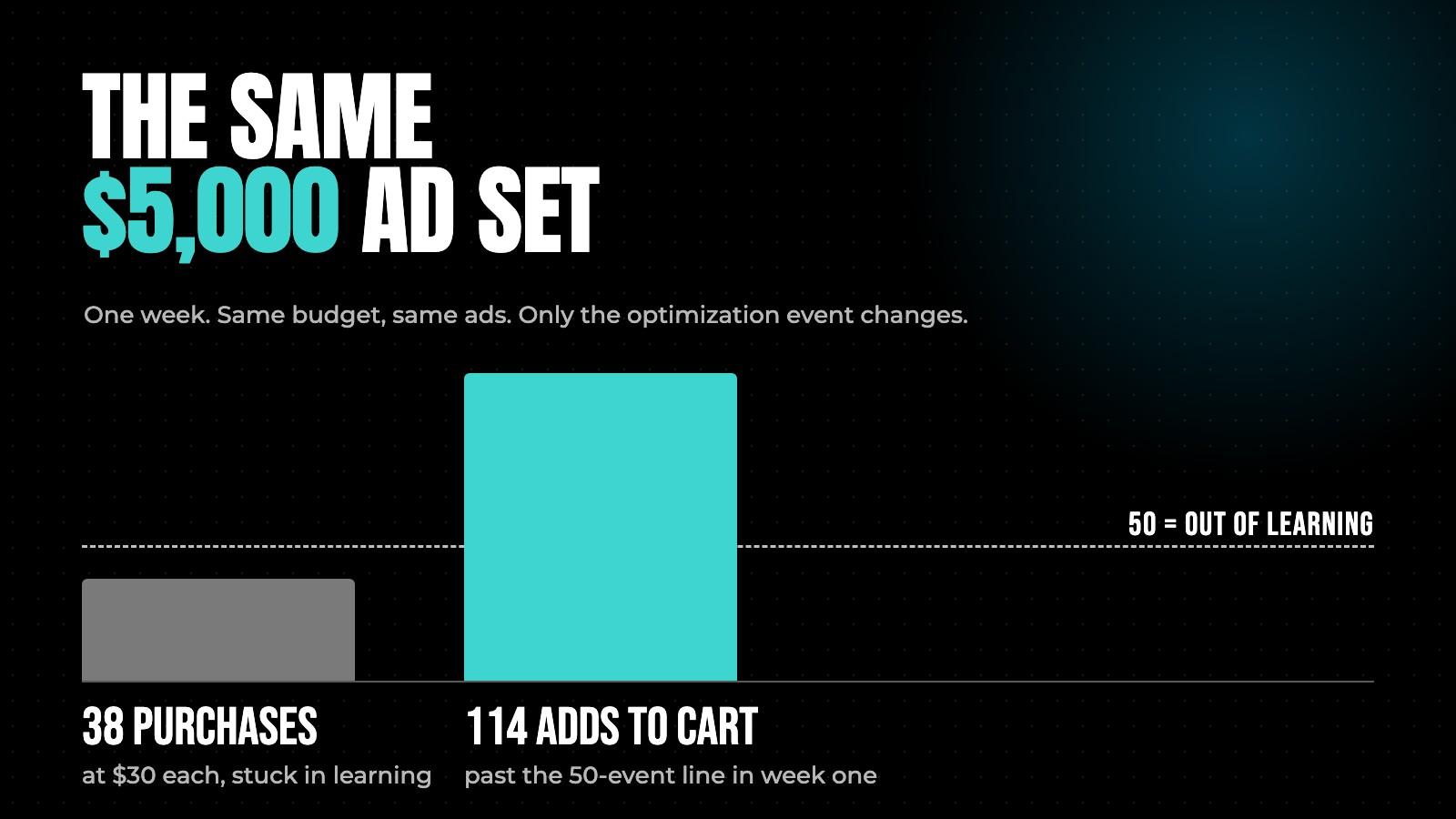
Look at the $5,000 row. At $30 a purchase you get 38 in a week, and that's with every dollar in one ad set. You never reach 50. Ads Manager labels the ad set "Learning limited," and Meta's page lists "an infrequent optimization event" as one of the reasons it happens. Switch the same ad set to adds to cart and it logs 114 of them. Learning finishes in the first week.
Now look at $10,000 and up. Purchases clear 50 on their own. At that spend, optimizing for add to cart is leaving money on the table.
The table assumes one ad set. Split $5,000 across four ad sets and none of them get anywhere, with either event. Meta's first fix for learning limited is "combine ad sets and campaigns," and we've watched that one move take a Shopify account from a 1.17 return to a 4.40 return.
So when should you optimize for add to cart?
Four situations.
A new ad account or a new pixel. Meta has no purchase history to learn from. Add to cart gives it something to work with in the first weeks instead of guessing.
Your budget can't fund 50 purchases a week. Run the math above. If one consolidated ad set can't get there at your real cost per purchase, you're going to sit in learning limited either way. Pick the event that lets the system settle.
A high-ticket product with a long think. A $600 purchase might happen two weeks after the click. Adds to cart happen on the day. Meta can't learn from a conversion that hasn't shown up yet.
You're testing creative on a small budget. Judging ads on purchases when each ad gets $50 a week is a coin flip. Adds to cart give you a read on hooks and offers sooner. The purchases still decide the winner, but you can see which ads are dead before the money's gone. Here's how many creatives a budget can carry before this becomes the problem.
And two situations where you shouldn't.
If your consolidated ad set already clears 50 purchases a week, stay on purchases. And if you've been on add to cart for two weeks, carts are cheap, and nobody buys, the event isn't your problem. The product page, the price, or the checkout is.
What's the catch?
Meta is very good at finding exactly what you ask for. Ask for adds to cart and you'll get adds to cart. Some of those people were never going to buy. Some add to cart on every store they visit.
So the number to watch changes. Cost per add to cart is a vanity metric. The numbers that matter are cost per purchase, purchase rate from cart, and return on spend, the same KPIs that tie to revenue you'd use on any campaign. If the add-to-cart setup gets a lower cost per purchase than the purchase setup did, it's working. If it gets cheap carts and the same number of sales, it isn't.
Two things to keep in place no matter which event you pick:
- Keep the Purchase event firing through the pixel and the Conversions API. You're still collecting purchase data while you optimize on carts, and that data is what lets you move up later.
- Keep the campaign objective on Sales. You're changing the event the ad set bids on, not what the campaign is for.
How do you move back to purchases?
Treat the switch as a one-time step, not a dial.
- Watch weekly purchases per ad set, not per account. When one ad set is logging close to 50, or your budget is rising enough to get there, it's time.
- Make the change once. Meta counts a change to the optimization event as a significant edit, so learning restarts. Flip back and forth and you'll live in learning forever.
- Expect a rough week. Results get noisy while the system relearns. Don't touch the budget, the audience, or the creative during that week. All of those are significant edits too.
- Keep ad sets consolidated so every purchase lands in the same place. Meta's Advantage+ sales campaigns push you this direction by default, and that's one of the few defaults worth keeping.
What about view content, landing page views, or initiate checkout?
Same ladder, further up. The weaker the event, the more of them you get and the less they mean.
Landing page views are for the first few days of a brand new pixel and nothing else. View content is almost as weak. Initiate checkout sits between add to cart and purchase, and it's a fair pick for a store where lots of carts become checkouts but the budget still can't fund 50 purchases. For most product brands, add to cart is the right middle rung. It's frequent enough to learn from and close enough to money to mean something.
Pick the event your budget can afford to learn from
That's the whole rule. Purchases when you can get 50 a week into one ad set. Add to cart when you can't. Move up when the numbers say so, and move once.
If you'd like a second set of eyes on your account, tell us your monthly spend and your cost per purchase. We'll tell you which event you should be on and whether your ad sets are split too thin to learn. We run paid, creative, and the content around it for product brands.